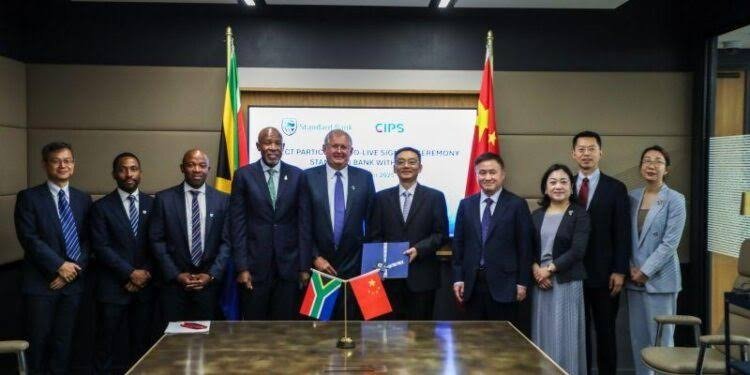
China has approved the establishment of a Renminbi (Yuan) clearing network across 19 African countries, marking a major milestone in the expansion of Yuan-based trade across the continent. The initiative, led by Standard Bank Group and the Industrial and Commercial Bank of China (ICBC), will enable businesses and financial institutions to settle cross-border transactions directly in Chinese Yuan, reducing reliance on the U.S. dollar. The People's Bank of China has authorized Standard Bank Group Ltd. and the Industrial and Commercial Bank of China (ICBC) to jointly operate as the Renminbi Clearing Bank of Africa, creating the continent's largest coordinated Yuan clearing network to date.
The approval allows businesses and financial institutions across 19 African markets to access China's domestic payment infrastructure directly. As a result, cross-border trade transactions can now be settled in Renminbi (RMB) without first converting funds into intermediary currencies such as the U.S. dollar. The initiative forms part of China's long-term strategy to expand the international use of the Yuan amid changing global trade dynamics and growing demand for alternative payment systems.
To support this strategy, China has continued investing in financial infrastructure such as the Cross-Border Interbank Payment System (CIPS), bilateral currency swap agreements, and offshore Yuan clearing centers across key global markets. Africa has become one of the most important regions in this expansion.
According to Chinese customs data, trade between China and Africa increased by nearly 18% over the past year. China has also removed tariffs on imports from 53 African countries, further strengthening commercial relations and encouraging greater use of the Yuan in cross-border trade. For Standard Bank, the continent's largest bank by assets, the approval builds on its admission into China's CIPS network in late 2025. The bank disclosed that it processed approximately $500 million in Yuan-denominated transactions during its first four months on the system, with trade finance accounting for most of the activity.
The development also reflects changing trade preferences among African businesses. According to Standard Bank's latest Africa Trade Barometer, 35% of businesses surveyed across ten African markets now identify Asia as their preferred trading partner, up from 24% a year earlier. China remains the leading source of imports for most respondents. While the new clearing network is unlikely to replace the U.S. dollar as the world's dominant settlement currency in the near future, it is expected to lower transaction costs, reduce settlement times, and improve African businesses' access to Chinese financial markets.
The launch of a Yuan clearing network across 19 African countries represents another significant step in China's efforts to strengthen its financial influence across emerging markets. By providing direct access to Renminbi settlement, the initiative is expected to make trade between Africa and China more efficient while reducing dependence on dollar-based payment systems.
As trade ties between both regions continue to deepen, the expansion of Yuan settlement infrastructure could play an increasingly important role in shaping the future of cross-border commerce across Africa.
Related Articles

Israel’s Largest Bank Becomes First Bank to Offer Crypto Trading Bank
Aug 18, 2026

Nigerian Crypto Exchange KoinKoin Partners with KuCoin Institutional to Expand Access to Crypto Liquidity
Aug 18, 2026

Bitcoin Cold Wallet Exploit Spreads to Over 4,500 Addresses as Losses Climb to ~$90 Million
Aug 13, 2026